



.svg.png)

Writing my first book taught me something I should already have known.
I do not do my best work in the cracks.
For most of my professional life, I have been able to move quickly. A coaching session, a client note, a proposal, an email, a bill, a WhatsApp message, a quick call, another email. I can shift from one thing to another with relative ease. At least that is what I used to tell myself.
I have never been formally diagnosed with ADD, and I am careful with those labels, but I recognize in myself a restlessness of attention. I like movement. I like variety. I like the small satisfaction of closing loops. Pay the bill. Answer the message. Send the note. Return the call. Each one gives a little sense of progress.
The problem is that writing a book does not respond well to little hits of progress.
When I started writing, I brought my normal working style into the process. I would find an hour between coaching sessions and tell myself, “Good, I can write now.” I would open the document, reread the last paragraph, fix a sentence, and then remember something urgent. A client email. A payment. A message I had not answered. Something that would “only take two minutes.”
Of course, it rarely took only two minutes.
By the time I returned to the page, the thread was gone. The emotional tone had shifted. The idea that had been warm a few minutes earlier had gone cold. I could still write words, but I was no longer inside the work.
This became a strange combination of frustration and satisfaction. Frustration because the book was not moving. Satisfaction because I had been busy. I could end the day with many things done and still feel the uncomfortable truth underneath: the work that mattered most had barely advanced.
The book was not suffering because I lacked commitment. It was suffering because I was treating it like admin.
That was the real lesson.
Some work can be done in fragments. Much of modern professional life is built around those fragments. Replying, reviewing, approving, forwarding, scheduling, checking. These tasks are not useless. Many of them are necessary. But they create the dangerous impression that all work can be handled in the same way.
A book cannot.
Neither can strategy. Neither can serious leadership thinking. Neither can a difficult conversation that requires you to understand your own part before speaking to someone else.
The research says what many of us already know in our bodies. Interruptions do not only take the time of the interruption itself. They also take the time it costs to return. They raise stress, increase effort, and make the mind work harder to find its way back. We may call this normal office life, but it is expensive. Expensive in attention. Expensive in quality. Expensive in the kind of thoughtfulness that better decisions require.
I did not need the research to tell me this was true. I was living it.
Trying to write in a one-hour gap between coaching sessions was not going to produce a book. It might produce a paragraph. It might produce a few edits. It might allow me to feel virtuous for having opened the document. But it would not produce the deeper movement a book requires.
So, I changed the structure.
I started blocking four-hour periods during the week for writing. Not full days. Not a cabin in the mountains. Just four protected hours, placed deliberately between other commitments.
At first, I still behaved like myself. I would spend the first twenty or thirty minutes avoiding the writing. I answered a few non-essential emails. Paid a bill. Checked something that did not really need checking. I used to judge that part harshly. Now I see it differently. It was a decompression chamber. My nervous system needed to empty the surface noise before I could go deeper.
Then something would settle.
The page stopped being another task and became the main task. A chapter would begin to show its shape. A story would connect to a concept. A sentence I had been forcing the day before suddenly became simple. I could see what belonged and what did not.
The difference was astonishing.
In a relatively small percentage of my total working time, I wrote most of the book. Not because I suddenly became more disciplined. Not because I found a perfect system. Not because distraction disappeared. The difference was simpler than that.
I had stopped asking fragmented time to carry unfragmented work.
This insight I am now also sharing in my coaching work.
Many of the leaders I work with live inside the same pattern. Their calendars are full. Their inboxes are alive. Their teams need them. They are responsive, available, informed, and tired. They are doing a lot, but the deeper work keeps moving to the next week.
The strategy they need to clarify. The decision they are avoiding. The memo that would align the team. The thinking about the next phase of the business. The family conversation that needs more than a quick call. The question of what kind of leader they are becoming.
None of these fits well into the gaps.
So, I started suggesting the same experiment: block three or four hours for the work that changes the quality of your leadership. Not catch-up time. Not inbox time. Not another meeting. A protected block for thinking, writing, analyzing, deciding, preparing, or understanding what is really going on before reacting to it.
Some resisted at first. “I cannot afford that.” “My team needs me.” “There is too much going on.” I understood all of it. I had said the same things to myself. But those who tried it often came back with a similar observation: “I got more done in that block than in the rest of the week.”
This is not a productivity trick. It is a leadership discipline.
The modern office rewards visible movement. Fast replies look responsible. Full calendars look important. Constant availability looks committed. But the work that most changes the future is often less visible while it is happening.
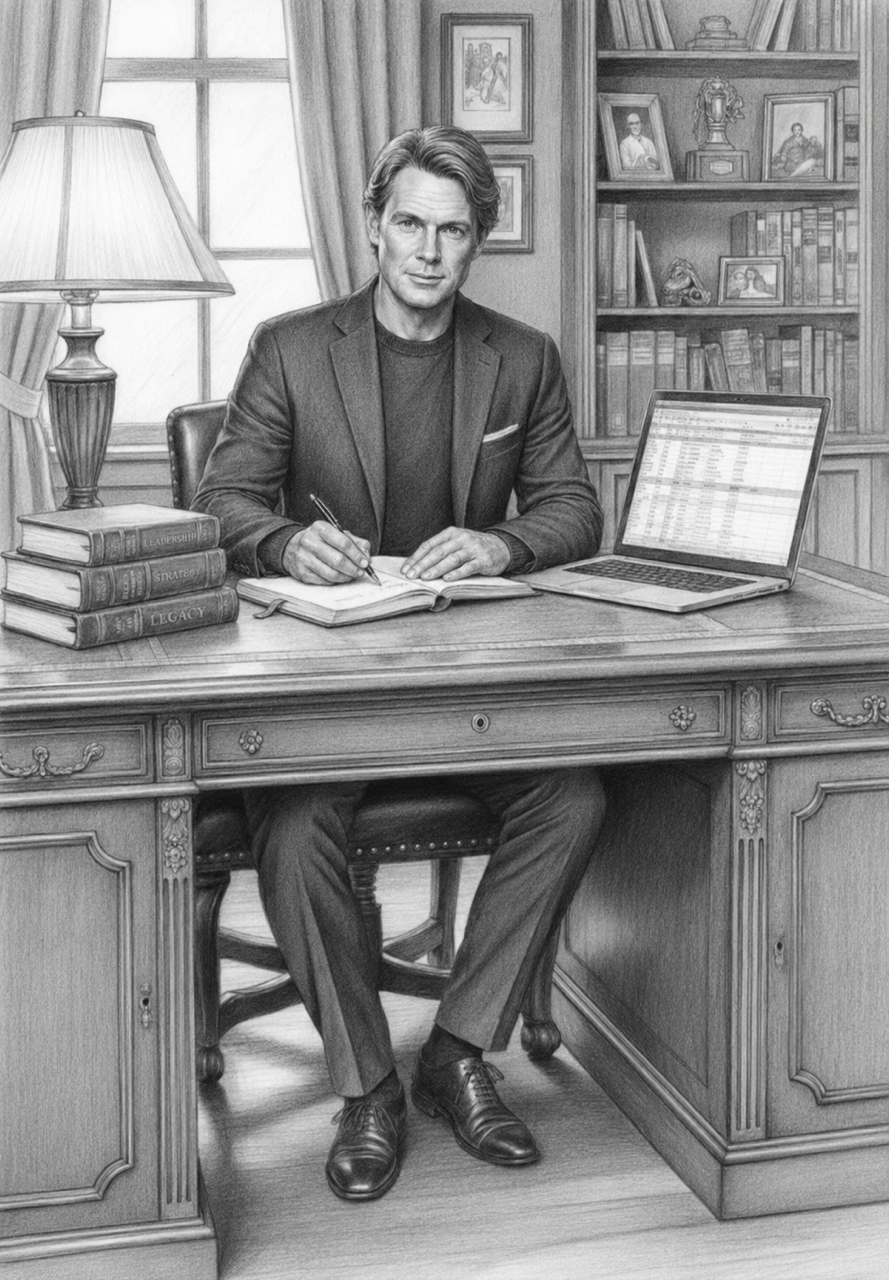
A leader sitting behind their desk with a hard question may look less busy than the person running from call to call. But that quiet hour may create more value than ten reactive meetings.
My problem was not lack of time. It was fragmentation. I had enough time, but too much of it was broken into pieces too small to hold the work I said mattered.
That is now the question I ask myself, and often ask the leaders I work with: Is your calendar built around your real work, or only around your visible work?
The answer is rarely comfortable. But the calendar usually tells the truth before we do.
--------------------------------------------------------------------------
Some interesting background material around this topic can be found in:
- Cal Newport, Deep Work: Rules for Focused Success in a Distracted World, New York: Grand Central Publishing, 2016. – In his book he argues that focused work is a rare and valuable skill in a distracted work culture.
- Adam Waytz, Beware a Culture of Busyness, Harvard Business Review, March–April 2023, This article mentions how looking busy has become a status symbol
- Microsoft, Breaking Down the Infinite Workday, Work Trend Index Special Report, June 2025 – This report signals that many workers lack uninterrupted focus time and spend a high share of time communicating rather than creating.








.png)


