

.svg.webp)


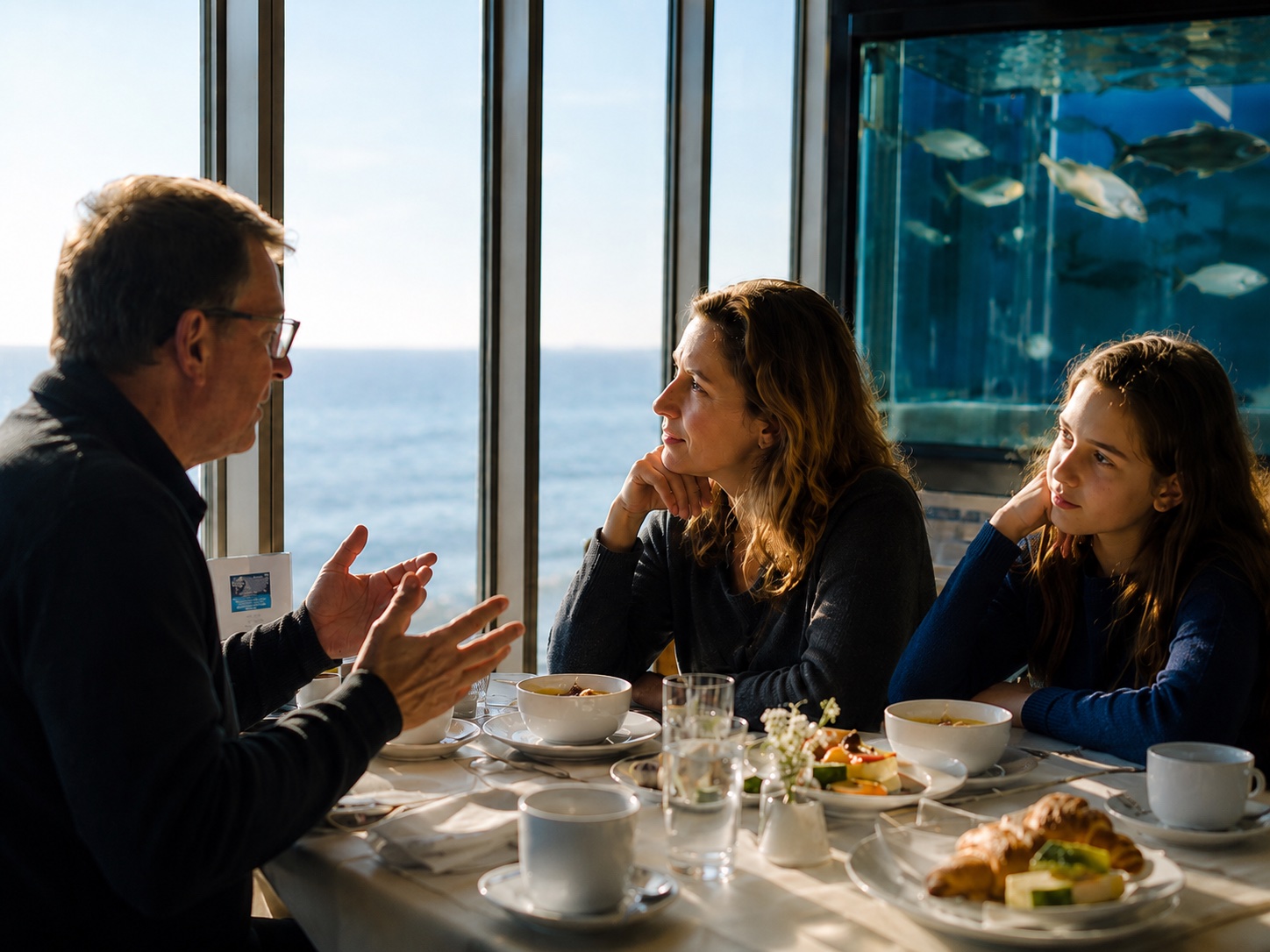
This morning, I had breakfast with a good old friend and business owner at a hotel on the Black Sea. Our table stood beside an enormous aquarium. Fish moved silently behind the glass, while beyond the windows the sea stretched toward the horizon.
We spoke in general terms about enterprise families and some of the difficulties they face.
We talked about relationships between generations, the responsibilities that accompany ownership, and the conversations families often postpone until circumstances force them to have them. We discussed how easily business decisions become family decisions, and how questions about money, fairness and leadership are rarely only about money, fairness or leadership.
My thirteen-year-old daughter was sitting with us.
She was not the subject of the conversation, and we were not trying to teach her anything. She was simply having breakfast while two adults talked about their work, their experiences and the complicated situations families sometimes find themselves in.
At first, she listened.
Then she asked, in essence:
“But if they are family, why don’t they trust each other?”
The question made both of us pause.
It was simple, but it was not superficial. She had picked up the themes beneath our conversation: fairness, responsibility, belonging, conflict and trust. In a few words, she had reached the human issue underneath much of the professional language we had been using.
My friend noticed this. He told me that he is a great admirer of the work of Lev Vygotsky, the Russian psychologist whose thinking focused on how children develop through social interaction, language and culture.
He spoke about the value of allowing children to be present during appropriate adult conversations. By listening to adults discuss real situations, children are exposed not only to information but also to ways of reasoning, questioning, disagreeing and solving problems.
I had never thought about it in quite those terms.
I am not a developmental psychologist, nor am I trying to become one. But as I looked beyond the aquarium toward the horizon, I turned the idea over in my mind: children do not learn only from the lessons we intentionally give them. They also learn by being close enough to hear how adults make sense of life.
Vygotsky was not writing specifically about children listening to adult conversations. Yet the moment seemed to reflect his broader insight: thought develops first between people before it takes shape within the individual.
Language does more than communicate what we already think. It helps form thought itself. Children first encounter ways of reasoning, explaining and solving problems socially. Over time, they begin to internalize those ways of thinking and make them their own.
Before children reason independently, they often experience reasoning between people.
That morning, my daughter was not receiving a formal lesson in family enterprise. She was hearing us distinguish between ownership and leadership, money and responsibility, equality and fairness, harmony and avoidance.
She was also hearing how two adults could explore a difficult subject, question one another and clarify their thinking without damaging the relationship.
This made me think about the enterprise families with whom I work.
Many families want the next generation to develop sound judgment. They hope their children will become responsible owners, grounded family members and thoughtful stewards of what earlier generations created.
Yet those same young people are often excluded from the conversations in which judgment is formed.
The adults discuss the business behind closed doors. They debate difficult decisions privately. They avoid speaking about wealth, failure, responsibility, conflict or succession because the children are “not ready.”
Years later, they may be disappointed that the next generation does not understand the complexity of the family enterprise.
But how were they expected to learn?
We expect young people to develop judgment while hiding the conversations in which judgment is developed.
Judgment is rarely transferred through one serious conversation when someone reaches a particular age. It develops gradually through exposure to how other people think.
A young person may hear that a decision can be commercially sensible but harmful to a relationship. They may discover that fairness does not always mean treating everyone identically, that responsible choices involve trade-offs, and that disagreement does not have to lead to distance.
These lessons are difficult to communicate through lectures. They are learned more naturally when young people hear adults working through real situations and are invited to ask questions about what they hear.
This does not mean that children should be exposed to every adult discussion. They should not be burdened with problems they cannot influence, drawn into disputes between family members or made responsible for an adult’s anxiety. Good boundaries protect children. But protecting them from destructive conflict is not the same as excluding them from every meaningful conversation about responsibility, choices and consequences.
Listening alone is not enough either.
What made the breakfast meaningful was that my daughter joined the conversation. She asked a question, and we took it seriously. We stopped, thought about it and tried to answer without hiding behind professional language.
Children do not simply absorb adult thinking. They interpret what they hear through their own experiences. Their questions reveal what they understood, what confused them and what adults may need to explain more clearly.
Sometimes those questions also expose the weaknesses in our reasoning.
It is easy for adults to use sophisticated language and assume we are making sense. A child’s direct question can cut through layers of analysis and return a conversation to its human centre.
Perhaps preparing the next generation is not mainly about waiting until they are ready for one large, formal conversation.
Perhaps readiness develops through years of smaller ones.
It grows when young people hear how decisions are weighed, how uncertainty is handled and how responsibility is discussed. It grows when adults explain not only what they decided, but how they arrived there.
Responsibility is not something suddenly handed over when a person turns twenty-five or thirty. It is a language learned much earlier.
That morning beside the aquarium, my daughter was not studying family enterprise. She was learning something about how adults work through difficult human situations.
And I was learning something too.
Perhaps the next generation becomes ready not only because of what we teach them directly, but because we allow them to remain at the table long enough to hear how we think.











.webp)