

.svg.webp)


A few nights ago, I found myself on the delightful island of Paros, in the Cyclades, surrounded by my family, the sea, and the easy beauty of a Greek summer evening.
We have been sailing around the islands for a few days. The rhythm is simple: wake up with the light, swim before breakfast, look at the wind, decide where to go, find a bay, drop anchor, eat too much, laugh, argue a little, laugh again. There is something wonderfully old-fashioned about being on a boat with your family. You cannot fully escape each other. You cannot disappear into separate rooms. You are close enough to be irritated, and close enough to remember why you love each other.
That evening, my kids had made a reservation at a restaurant. I did not know much about the place. I assumed we were going for a pleasant dinner, some souvlaki and grilled fish, a Greek salad, a glass of white wine, a view of the harbor. The kind of evening where conversation slowly softens as the plates are cleared and the night settles around the table.
For a while, that is exactly what it was.
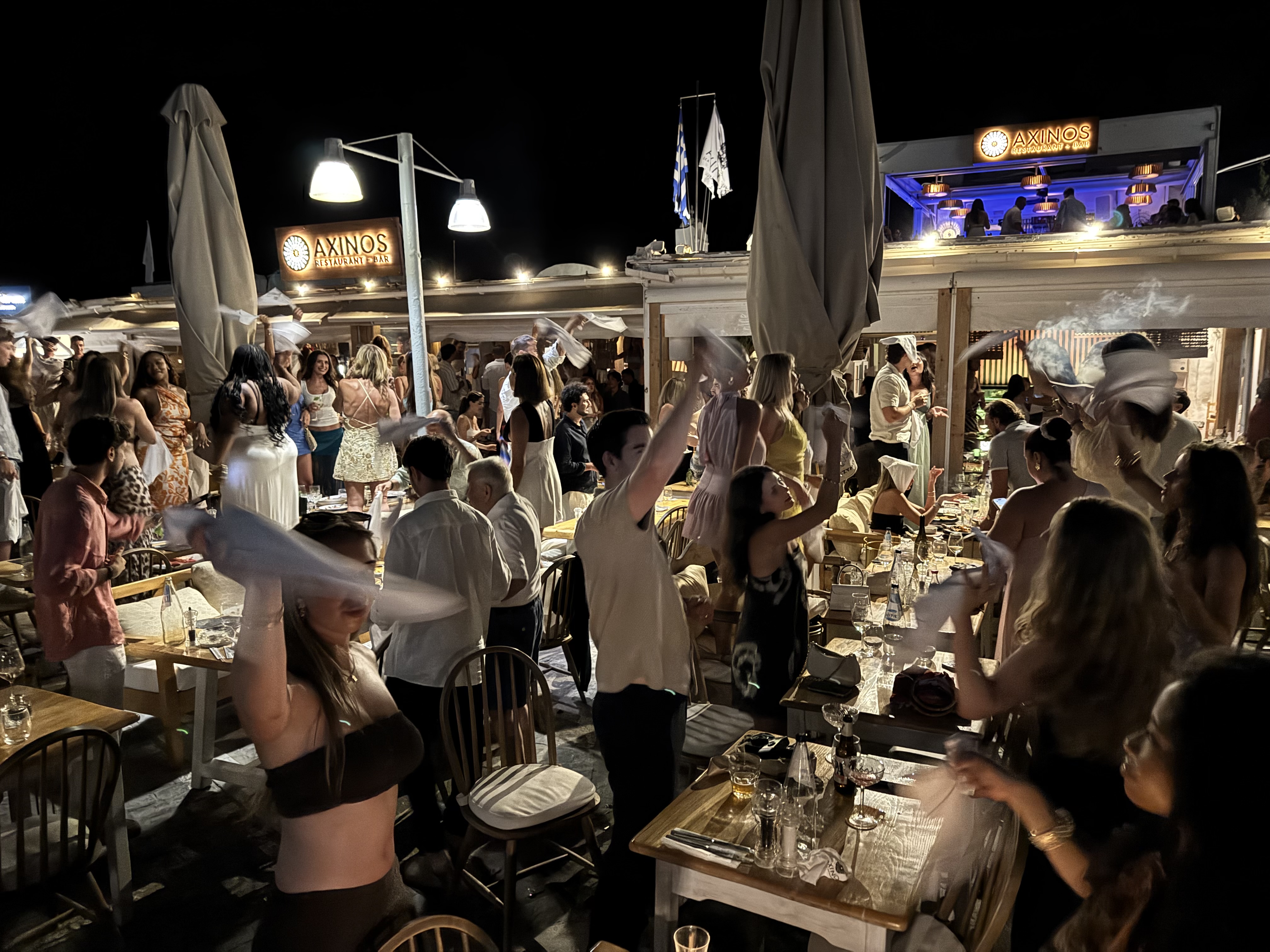
Then suddenly, later in the evening, the music changed. The volume was turned up. A techno version of traditional Greek bouzouki music started blasting through the restaurant. Before I had fully understood what was happening, people were standing on chairs and tables, swinging their napkins above their heads.
My kids knew. I did not.
There was no time to analyze. No time to decide whether this was tasteful, ridiculous, authentic, touristy, or something in between. The napkins were already in the air. The tables were already shaking. The music was already too loud for any serious conversation.
So we joined.
And for a while, it was fantastic.
There is something liberating about being taken out of yourself. About being pulled into a scene before your self-consciousness has time to object. You laugh because everyone else is laughing. You wave the napkin because the person next to you is waving one. You become part of a collective absurdity. Nobody is important. Nobody is elegant. Nobody is fully in control.
For those first minutes, it felt spontaneous. Unexpected. Funny. A little wild. The kind of moment that becomes a family story later: “Remember that night in Paros when we all ended up dancing with napkins?”
But then something shifted.
After ten or fifteen minutes, the music continued. The napkins continued. The dancing continued. The energy did not really grow, but it kept being performed. The Greek music gave way to other songs, including, inevitably, ABBA. People were still standing on chairs and tables, still waving their napkins, still acting as if the first moment had not passed.
At the same time, people on the quay beside the restaurant began to stop. They took out their phones. They started making photos and videos of the wild, exuberant scene inside.
And something curious happened.
The people inside seemed to notice the people outside. The napkins swung faster. The gestures became larger. The laughter became louder.
What had begun as a spontaneous eruption of joy slowly became something else.
It became a scene.
“Look how much fun we are having.”
I do not mean this as criticism. I was part of it too. I was there, napkin in hand, laughing with my family. But I could feel the shift from experience to performance. From being in the moment to showing the moment. From joy to the representation of joy.
And I wondered how often this happens before we notice.
A dinner becomes a story while it is still happening. A holiday becomes a photograph before we have fully enjoyed the view. A conversation becomes something we are already preparing to describe to someone else.
The phones make this more visible, but they did not invent it. Long before social media, we were already learning how to be seen.
At first, the role begins lightly, almost playfully. Like a napkin in the air. It gives energy. It connects us. It helps us enter the scene.
But then the moment passes, and we keep waving.
That was what I felt after those first fifteen minutes. The fun had not disappeared, but effort had entered the room. The laughter became louder than the laughter needed to be. The gestures became a little larger. Somewhere, without anyone deciding it, the evening had acquired an audience.
A child knows this feeling in its purest form. He jumps into the pool, comes up for air, and immediately looks back: “Did you see me?” At that age, the question is innocent. Joy wants to be witnessed.
Later in life, the same question becomes more complicated.
Did you see how successful I am?
Did you see how happy we are?
Did you see how calm I remained?
Did you see how much fun I am having?
And sometimes, without meaning to, the seeing becomes more important than the living.
I thought about this while sitting there with my family, the harbor lights behind us, ABBA filling the restaurant, napkins still flying above our heads. It was funny and slightly ridiculous, but also familiar.
I see versions of this in many rooms.
A founder performs certainty long after he has private doubts. A successor performs readiness because the family needs to believe the transition will work. A family performs harmony at dinner, while everyone knows which subjects cannot be touched.
Nobody is necessarily lying. That is the interesting part. The performance usually contains truth. The founder is capable. The successor may be ready. The family may love each other.
But when the role becomes too important, it begins to cover the rest of the truth.
Not all at once. More like slowly turning up the music until we cannot hear our own inner voice anymore.
At first, we choose the role.
Then the role chooses our next move.
The strong one cannot ask for help. The wise one cannot say, “I don’t know.” The generous one cannot say no. The successful one cannot admit fatigue. The parent cannot show uncertainty.
And the napkin keeps moving.
Perhaps maturity is knowing when we are still alive in the role, and when we are only repeating it.
There was nothing wrong with the dancing in Paros. I loved it. I will remember it. My kids had set me up beautifully, and I was happy to be surprised by them. We laughed. We participated. We became part of the madness.
But I also noticed the moment when joy began to look over its shoulder.
Life asks us to participate, not only to perform. To enter the dance, but also to notice when the dance has become a show.
Every so often, we need to pause and ask:
Am I still choosing this?
Or am I now performing for the people on the quay?
That night in Paros, I eventually lowered my napkin.
Not because the evening had become false. Not because I was above it. I was not. I had been part of it, happily.
But because I wanted to feel the night again without needing to prove that I was having fun.
The music was still loud. The harbor was still beautiful. My family was still around the table. The Cyclades were still doing what they do so well: making life feel a little lighter, a little warmer, a little more generous.
And maybe that was enough.
No faster napkin required.








.webp)