



.svg.png)

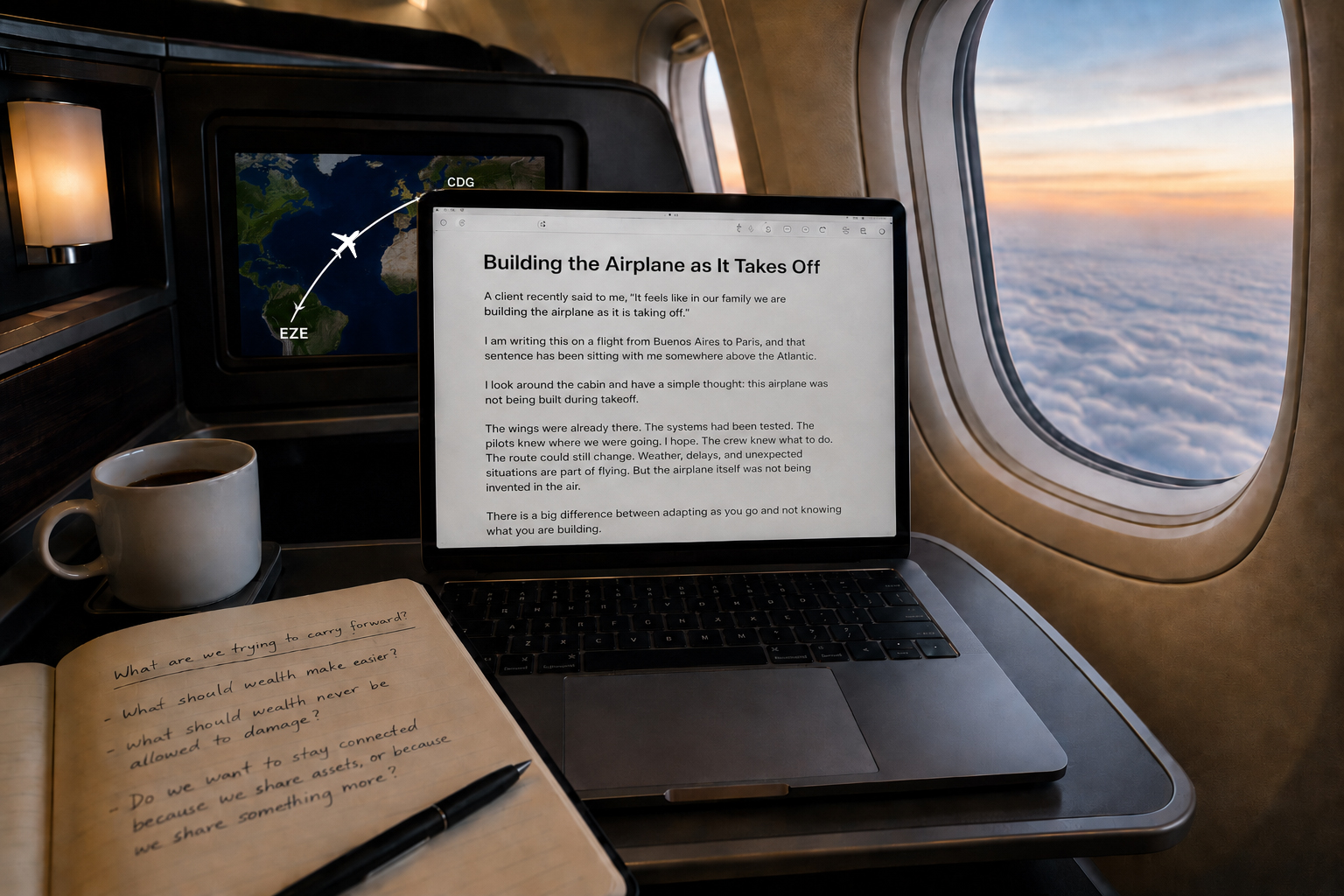
Building the Airplane as It Takes Off
A client recently said to me, “It feels like in our family we are building the airplane as it is taking off.”
I am writing this on a flight from Buenos Aires to Paris and that sentence has been sitting with me somewhere above the Atlantic.
I look around the cabin and have a simple thought: this airplane was not being built during takeoff.
The wings were already there. The systems had been tested. The pilots knew where we were going (I hope). The crew knew what to do. The route could still change. Weather, delays, and unexpected situations are part of flying. But the airplane itself was not being invented in the air.
There is a big difference between adapting as you go and not knowing what you are building.
In families, business, and life, we often begin before the destination is fully clear. Sometimes that is fine. More than fine, it can be healthy. Not everything needs a plan.
Some of the best family moments happen without structure. A Sunday lunch that goes long. A conversation in the car. A joke that becomes family language. A child asking a question no one expected. A story told by a grandparent that opens something in the next generation.
Families need space for that. They need humor, creativity, and surprise.
But the opposite also carries a cost.
When a family avoids structure for too long, the important questions do not disappear. They wait in the background until the moment becomes harder. Succession is postponed. Ownership stays vague. Conflict is left unnamed. The next generation is left guessing. The future of the business is treated as something that can be handled later, until later arrives with pressure.
Then one day the family discovers that what felt informal was actually unclear.
I have seen this often.
A family wants to organize succession, protect wealth, set up a family office, prepare the next generation, create a board, write a family charter, or define ownership rules. None of that is wrong. In many cases, it is wise and necessary.
The risk begins when the family starts with the tool before it has named the purpose. Should we create a family council? Maybe. But what do you actually need to talk about as a family?
How do we prepare the next generation? Important question. But prepare them for what kind of role, responsibility, and life?
How do we protect the wealth? Fair question. But what do you hope the wealth will make possible?
Who should own what? It matters. But what does ownership mean in this family beyond legal rights?
When those deeper questions are missing, the family starts building the airplane in midair. Not because people are careless. Often, the opposite is true. They care deeply. They may be working with strong advisors and making serious efforts to avoid future conflict. The problem is that the work becomes technical before it becomes human.
It is like a company investing in IT infrastructure without first asking what the business needs the system to do. New platforms are installed. Dashboards are designed. Reports are produced. Access rights are defined. It all looks professional. But if the company what decisions the data should support.
Families can fall into the same trap. They create a structure and then hope purpose will appear inside it. The older generation wonders why the younger generation is not more engaged. The younger generation senses that everything comes with obligation but little meaning.
This is why purpose matters before structure. Not words polished for a family constitution and forgotten after the meeting. I mean a more honest kind of purpose. The kind that can survive a real conversation.
What are we trying to carry forward?
What should wealth never be allowed to damage?
Do we want to stay connected because we share assets, or because we share something more?
These questions are practical because they shape the choices that follow: governance, ownership, education, succession, philanthropy, and how conflict is handled. They decide whether a structure will help the family or simply give it another layer to manage.
A trust or foundation can protect assets, but it cannot create trust between siblings. A family office can manage wealth, but it cannot answer what the wealth is for. Constitutions, councils, and next generation programs can all help, but only when they serve a purpose the family has actually named.
The airplane needs more than equipment. It needs direction.
That does not mean every family needs one shared dream. Some families are too diverse for that, and forcing false unity can create more damage than clarity. A useful North Star does not erase difference but it may give the family enough direction to make better decisions.
For one family, the direction may be responsible ownership without pressure to work in the business. For another, it may be giving the next generation opportunity without creating entitlement. Another family may need to repair trust between branches before building new structures. Another may be preparing for a sale and asking how to remain a family once the operating business is gone.
Each answer leads to different work.
When purpose is clearer, the practical choices improve. Education becomes preparation for the responsibility the family actually wants people to carry. A family council becomes the right room for the right conversations, not a borrowed governance idea. Succession becomes more than naming the next leader. It becomes a decision about what kind of leadership the future requires.
The structure should follow the purpose. Not the other way around.
Of course, families do not always get ideal timing. A founder becomes ill. A parent dies. A business is sold. A conflict erupts. A deadline appears. Suddenly the family has to move before it feels ready.
In those moments, the airplane may already be rolling down the runway.
Even then, one question can help: What are we trying not to lose?
That question does not stop the work. It gives the work a center. Once that is named, the conversation changes. The family is no longer only trying to finish documents or make decisions under pressure. It is trying to protect something human while dealing with real business and financial consequences.
The best families I have seen do not choose between spontaneity and structure. They understand the need for both.
They keep enough informality for family life to stay alive. They also know when the moment calls for deeper thought, clearer agreements, and better conversations.
Sometimes we do have to build while flying. That is life.
But when we have the chance, we should ask what the airplane is meant to carry before it leaves the ground. And where we hope it is taking us.






.png)


